


Hemp vs Marijuana vs Kratom—Origin, Active Compounds, and Its Legality!
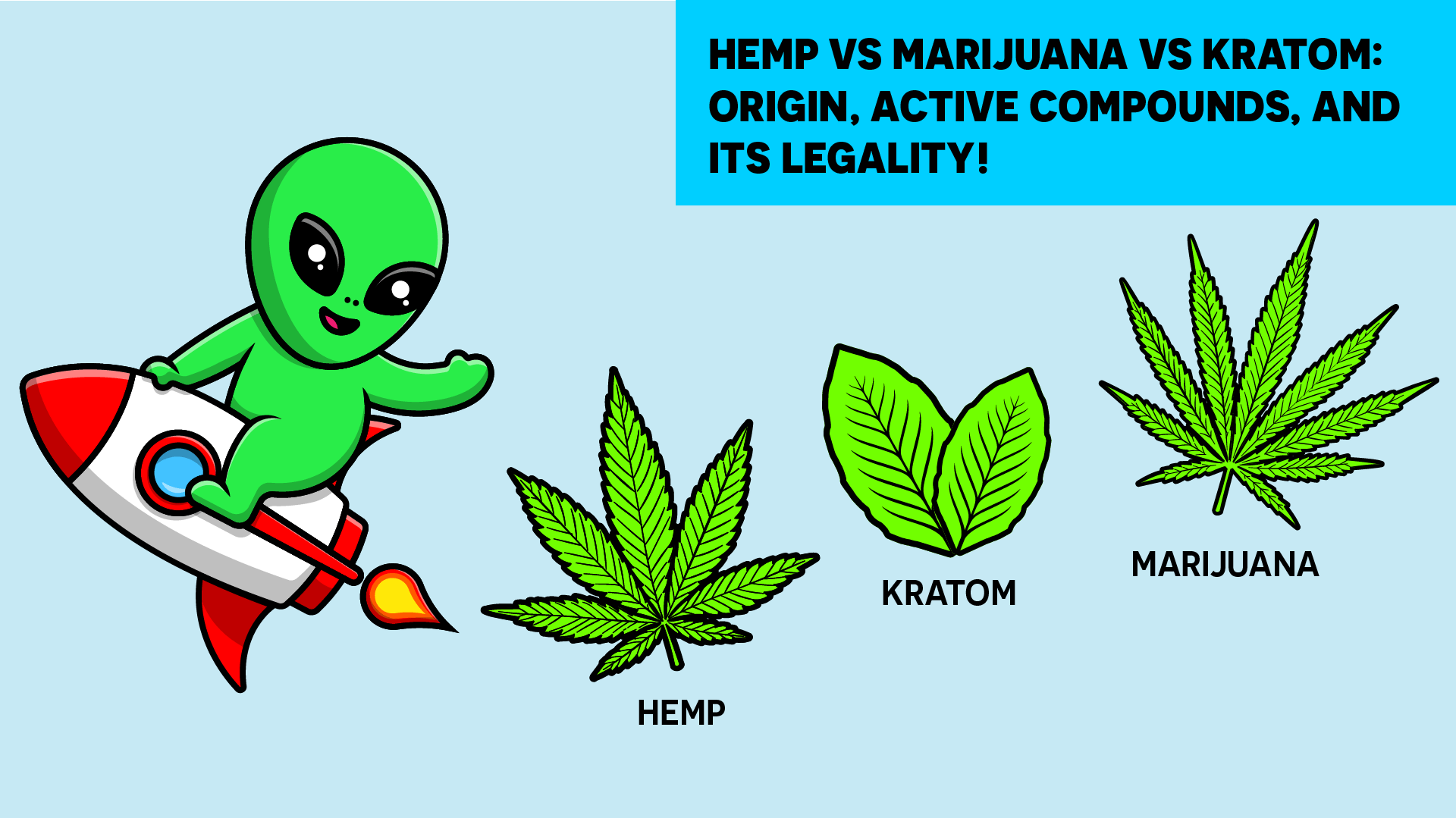
Hemp, marijuana, kratom… they all live in the same conversation, but they couldn’t be more different. One helps you calm down, another gives you the intoxicating effect, and the third depends entirely on how you take it.
We’ve seen the confusion firsthand. People often ask if kratom is just another form of weed or assume that hemp is simply a milder version of marijuana. It makes sense; they all come from nature, and they show up in similar forms. But once you break it down, these three have totally different stories.
They’re not from the same plant family. They don’t work the same way in your body. And they definitely don’t feel the same.
So, if you’ve ever stood in front of a shelf of botanical products wondering what does what or want to know why some people consume while others light up a joint, you’re in the right place.
Plant Families & Origins
Let’s start with the basics of where each of these plants actually comes from.
Hemp and marijuana both trace back to the Cannabis sativa plant: same species, different varieties. Depending on how it’s grown, the plant ends up either as industrial hemp or marijuana, but genetically, they share the same roots.
Kratom, on the other hand, comes from a tropical evergreen tree called Mitragyna speciosa, native to countries like Thailand, Indonesia, and Malaysia. It’s part of the coffee family, and while that doesn’t mean it tastes anything like your morning brew, it tells you a bit about where its natural energy comes from. So, while hemp and marijuana are closely related botanically, kratom is from a whole different family tree. That starting point shapes everything that comes next.
Active Compounds
Once you understand where these plants come from, the next step is to determine the compounds that actually make you feel something.
Hemp & Marijuana
Even though hemp and marijuana come from the same plant species (Cannabis sativa), the way they affect the body comes down to their mix of cannabinoids, mainly THC and CBD.
- Hemp – Contains less THC (not more than 0.3%), and more CBD
- Marijuana – Contains more THC (ranging from 15-20% and sometimes as high as 30% or 33%), and less CBD
THC (delta-9-tetrahydrocannabinol) is the one that gets all the attention. It’s the compound responsible for the high number of people associate with marijuana. When cannabis is heated (that’s through smoking, vaping, or cooking), THC becomes active and starts interacting with your brain’s cannabinoid receptors, especially the CB1 receptor. That’s where the euphoric, heady effects come from.
Now, hemp still has trace amounts of THC, but legally, it can’t go above 0.3% by dry weight. So, it won’t get you high at most; it helps you feel a little more balanced or relaxed, especially when paired with CBD.
Speaking of which, CBD is non-intoxicating, and it works a bit differently. It actually softens the effects of THC by changing how those receptors respond. Most hemp-based products are high in CBD, and that’s why people often turn to them for stress relief, focus, or sleep.
There are also over a hundred other cannabinoids in cannabis, like CBG, CBN, and THCV, each with its subtle roles. And let’s not forget the terpenes and flavonoids that contribute to aroma, flavor and some of the entourage effects. But for most people, the CBD-to-THC ratio is what really makes/breaks the experience.
Kratom
Kratom isn’t even in the cannabis family. Its power comes from two main alkaloids: mitragynine and 7-hydroxymitragynine.
Mitragynine makes up the bulk of kratom’s effect. It interacts with multiple systems in the body, including opioid, dopamine, and serotonin receptors, which is why it can feel stimulating at low doses and more sedative at higher doses. It’s complex, and its effects can depend on how much you consume and your response.
7-hydroxymitragynine, on the other hand, is more potent but found in much smaller amounts in the raw plant. Most of it is created inside the body as mitragynine breaks down.
There are also dozens of other alkaloids in kratom. This mix is what gives kratom its unique profile: energizing, calming, and a lot different from cannabis in every way.
Read More: What is the Best Kratom for Energy?
Legality & Regulation
When it comes to hemp, marijuana, and kratom, understanding what’s legal where (and how) is important for anyone curious about these plants’ potential.
Hemp
It is federally legal in the U.S. since the 2018 Farm Bill as long as it has less than 0.3% THC. It can be grown, sold, and consumed across most states, but CBD products from hemp aren’t FDA-approved.
Widely used for:
- CBD oils, capsules, and skincare
- Hemp protein, seeds, and oil
- Textiles, rope, and even biofuel
Some countries allow hemp with strict THC limits; others use it mainly for industrial goods.
Marijuana: Federally Illegal, State-by-State Legal
It is still illegal under U.S. federal law and classified as a Schedule I drug. Legalized by many states:
- Medical use in 38+ states
- Recreational use in 24+ states
Used for:
- Pain, nausea, appetite loss, insomnia
- Medical conditions like epilepsy, MS, HIV/AIDS
- A few THC-based drugs (like Dronabinol) are FDA-approved, but not cannabis itself.
The ongoing push to reclassify it federally could change everything soon.
Kratom
- It’s not federally banned. It is legal in most states but banned in a few (like Alabama, Indiana, and Wisconsin).
- Some states have passed Kratom Consumer Protection Acts, requiring:
- Age restrictions (18+ or 21+)
- Product purity and label transparency
- Used for pain relief, energy, focus, and easing withdrawal
Risks come from unregulated products — possible contamination, adulteration, or inconsistency.
Forms and Consumption
The way these three botanicals are consumed can dramatically affect how they feel, how fast they work, and how long the effects last.
Hemp
- CBD Oils & Tinctures – Usually taken sublingually (under the tongue) for quick absorption.
- Tablets – A convenient way to integrate CBD into a daily supplement routine.
- Edibles (like gummies or chocolates) – Popular for their taste and slow, steady effects.
- Smokable Hemp Flower – Offers fast effects, though less common than THC-rich strains.
- Vape Products – For those looking for fast-acting CBD without the harshness of smoking.
- Topicals (creams, balms) – Applied directly to the skin for localized relief (pain, inflammation).
- Hemp Seeds & Protein Powder – Consumed for their nutritional value, not cannabinoids.
Marijuana
- Smoking (joints, pipes, bongs) – The classic method, fast-acting and easy to control.
- Vaping (flower or concentrates) – Gentler on the lungs, still fast-acting.
- Edibles (gummies, brownies, drinks) – Slower to kick in, longer-lasting, and can hit hard.
- Tinctures & Oils – Dropped under the tongue or mixed with food/drinks.
- Capsules & Pills – Precise dosing, often used in medical settings.
- Topicals – Used for localized relief without the high.
- Concentrates (wax, shatter, resin) – Potent and fast-hitting, used by experienced users.
Consumption choices here often depend on why someone’s using it: for pain, sleep, anxiety, or just winding down. In regulated markets, strain options and terpene profiles give users more personalized experiences.
Read More: Best Delta 9 Products You Should Try in 2025
Kratom
Kratom users often choose their form based on how fast they want the effects or how much they can tolerate the taste.
- Powder (Loose Leaf) – Mixed with water, juice, or shakes. Most popular, fastest-acting.
- Capsules/Tablets – Ideal for those who want to avoid the bitter taste.
- Kratom Shots – Concentrated liquid extracts that are fast-acting and portable.
- Tea (Brewed from dried leaves or powder) – Traditional method, popular in Southeast Asia.
- Resins & Extracts – More concentrated and potent, used in smaller doses.
- Gummies & Edibles – A newer, tastier way to consume kratom.
We’ve found that most people exploring kratom for the first time prefer 7-OH tablets or 7-OH shots; they’re easier to manage and dose. At Elyxr, we’ve leaned into these formats to keep things smooth and approachable.
Read More: 5 Best 7-OH Shots You Should Try in 2025
Comparison between Hemp, Marijuana, and Kratom
| Category | Hemp | Marijuana | Kratom |
| Plant Type | Cannabis sativa (≤ 0.3% THC) | Cannabis sativa (> 0.3% THC) | Mitragyna speciosa |
| Main Active Compounds | CBD (non-psychoactive), trace THC | THC (psychoactive), CBD | Mitragynine, 7-hydroxymitragynine |
| How It Feels | Generally non-intoxicating; calming or energizing | Psychoactive high – can be relaxing, euphoric, or sedating | Biphasic: stimulating at low doses, sedating/pain-relieving at high doses |
| Primary Uses | Wellness supplements, skincare, textiles, nutrition (hemp seeds/oil) | Medical (e.g., chronic pain, nausea), recreational use | Pain relief, mood support, energy boost, withdrawal aid |
| Federal Legal Status | Legal under 2018 Farm Bill | Federally illegal (Schedule I drug) | Not illegal, but flagged by FDA & DEA as a concern |
| State Legal Status | Legal in most states; some variation on products like CBD | Varies: legalized for medical and/or recreational use in many states | Legal in most, banned in some (e.g., AL, IN, RI); others regulate via KCPA |
| Common Side Effects | Minimal — if pure | Dry mouth, red eyes, anxiety, paranoia (depends on strain & dosage) | Nausea, constipation, dependence, withdrawal, sedation (at higher doses) |
| Risks/Warnings | Mislabeling, contamination, unregulated CBD potency | Overconsumption, dependence potential, legal consequences in some areas | Contamination risk, unregulated products, dependency, lack of safety data |
| Research Status | Active, especially on nutrition and industrial value | Expanding, especially on medical use and cannabinoid science | Limited but growing focus on addiction, withdrawal, pain relief |
| Cultural Use History | Ancient use for fiber, rope, and food | Ritual, medical, and recreational use for centuries | Traditional labor aid & medicine in Southeast Asia |
| International Status | Legal in many countries with low THC limits | Illegal in many, though trend toward legalization is growing | Controlled or banned in many; legal in some (e.g., Thailand, Indonesia) |
Not sure what to try?
Hemp, marijuana, and kratom might share roots in nature, but the way they interact with our minds, bodies, and laws is wildly different. So… where does that leave you? Right here — with us. We carry a curated collection of hemp-derived cannabinoids and kratom products, including Delta-8 vapes, THC Disposables, kratom tablets, and even CBD gummies, all third-party tested, clearly labelled, and made with care, designed to meet you where you are.
- New to all this? Try a low-dose CBD gummy or kratom tablet, which is easy, portable, and beginner-friendly.
- Looking for a balanced experience? Our delta-9 edibles deliver just enough lift without going overboard.
- Need relief so you can feel fast? Explore kratom shots or THC vapes for faster onset.
And if you’re still feeling overwhelmed, our product pages contain helpful information (and we’re always here to answer questions, too). Explore our lineup at elyxr.com, and let your wellness routine evolve with a little curiosity and a lot more clarity.