




Full-Spectrum vs. Broad-Spectrum vs. Isolate: What’s Actually in Your Product
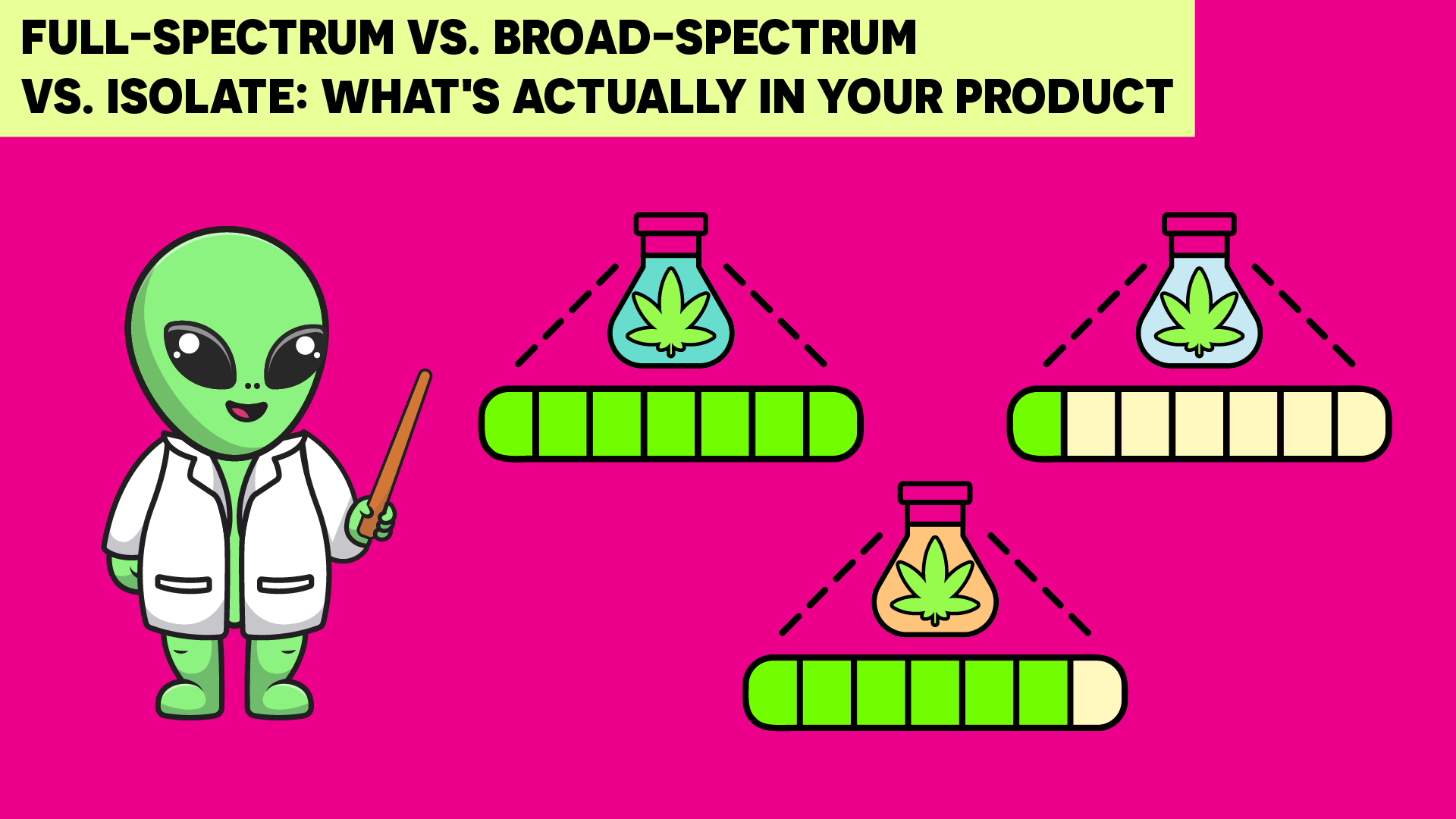
Pick up almost any hemp product off a shelf and you will see one of three words somewhere on the label: full-spectrum, broad-spectrum, or isolate. Most people glance past them the way they glance past “non-GMO” on a box of crackers, assuming it is marketing language without much substance behind it. It is not. These three terms describe genuinely different products with different compound profiles, and the differences show up in how the product actually affects you.
If you have ever switched between products and noticed one felt noticeably different from another even though the CBD milligram count was identical, this is almost certainly why.
Full-Spectrum: The Whole Plant, Minus Nothing
Full-spectrum is the least processed of the three. When hemp is extracted and nothing is stripped out afterward, you end up with a product that contains CBD alongside the full range of other compounds naturally present in the plant. That includes minor cannabinoids like CBG, CBN, and CBC, the terpenes responsible for aroma and flavor, flavonoids, and trace amounts of THC, capped at 0.3 percent or less on a dry weight basis to stay within the legal hemp definition.
That trace THC is the detail that trips people up. It is a small enough amount that it is not going to produce the effects associated with higher-THC cannabis products, but it is also not technically zero, which matters for anyone who needs to pass a drug test or who simply wants to avoid THC entirely for personal reasons.
The appeal of full-spectrum comes down to what is often called the entourage effect, the idea that all these compounds working together produce a different, and many users believe more noticeable, result than any single compound taken alone. This is still an evolving area of research rather than settled science, but it is the reasoning behind why full-spectrum products tend to have a loyal following among people who have tried isolate and felt like something was missing.
Broad-Spectrum: Almost Everything, Minus the THC
Broad-spectrum sits in the middle, and it exists specifically to solve the one concern full-spectrum can’t fully address. The process starts the same way, with a full extraction that captures the complete range of cannabinoids and terpenes. From there, manufacturers use additional processing, typically a chromatography step, to specifically target and remove the THC while leaving the rest of the compound profile intact.
What you are left with is a product that still contains CBG, CBN, CBC, terpenes, and flavonoids, giving you much of the same multi-compound profile that full-spectrum offers, but without detectable THC. This makes broad-spectrum the middle-ground choice for people who want the potential benefits of a fuller compound profile without the trace THC that comes with full-spectrum.
It is worth knowing that “THC-free” on a broad-spectrum label usually means non-detectable by standard testing, not a mathematical zero in every single molecule. For almost everyone this distinction doesn’t matter in daily life, but for anyone in a zero-tolerance testing situation, it is worth understanding that nuance rather than assuming broad-spectrum offers an absolute guarantee.
Isolate: Just the One Compound
Isolate is the most processed and the most stripped-down of the three. Manufacturers take the extraction process further, refining it until virtually everything except the target cannabinoid, usually CBD, is removed. The end result is a crystalline powder that tests at around 99 percent pure CBD, with no detectable THC, no terpenes, and none of the other minor cannabinoids that show up in the other two formats.
Because it contains nothing but the isolated compound, isolate is the most predictable and controllable option from a dosing standpoint. If you want to know exactly how much CBD you are taking without any other variables in the mix, isolate removes the guesswork. It is also completely flavorless and odorless, which makes it easy to add into other products like food or drinks without changing the taste.
The tradeoff is that isolate does not offer the entourage effect that full-spectrum and broad-spectrum users describe, simply because there is nothing else in the product to work alongside the CBD. Some users who have tried all three report that isolate feels more subtle to them compared to the other formats, though this varies a lot from person to person and is not something you can predict in advance.
So Which One Should You Actually Choose
There isn’t a universal right answer here, because the three formats are solving for different priorities.
If avoiding THC entirely is a hard requirement, whether for a job, a personal preference, or peace of mind, isolate or broad-spectrum are the formats worth focusing on, with isolate being the more absolute option of the two since broad-spectrum still involves a removal process rather than starting from zero.
If you are drawn to the idea that hemp compounds may work better together than any one compound alone, full-spectrum is the format actually built around that idea, and it is worth trying if you haven’t already, as long as the trace THC isn’t a concern for you.
If you want a clean, simple, easy-to-dose product without thinking about anything beyond the CBD number on the label, isolate does that job well, and it is often the most budget-friendly option since it is simpler to manufacture at scale.
Broad-spectrum is the compromise pick for people who want more than isolate but are not comfortable with any THC at all, even in trace amounts. It is frequently the best fit for new users who are curious about full-spectrum’s reputation but want to start somewhere with fewer variables.
Reading a Label the Right Way
None of this matters if the product itself isn’t backed by real lab testing. A legitimate product, regardless of which of the three formats it is, should come with a certificate of analysis you can actually access, showing what cannabinoids are present and at what levels, confirming the THC content is within legal limits for full-spectrum and broad-spectrum, and verifying there’s nothing you weren’t told about in the mix.
Labels that just say “full-spectrum” or “isolate” without backing that claim up with testing are asking you to take their word for it, which is not the same as proof. The format matters, but only if the product is honest about what format it actually is.
Why the Same Format Can Still Feel Different Between Brands
One detail that confuses a lot of people after they’ve picked a format is discovering that two full-spectrum products from different brands don’t feel the same. This comes down to the fact that “full-spectrum” describes a category, not a fixed formula. The specific ratio of CBG, CBN, and CBC, the terpene profile, and even the exact hemp cultivar used all vary between producers, which means two full-spectrum products can have a meaningfully different compound makeup even though both qualify for the same label. The same logic applies to broad-spectrum, where the specific compounds retained after THC removal can vary depending on the producer’s process. Isolate is the one format where this variability mostly disappears, since by definition there’s little left in the product besides the single cannabinoid, which is part of why isolate products tend to feel more consistent brand to brand than the other two formats.
A Few Common Questions
Will broad-spectrum or full-spectrum show up on a drug test?
Isolate is the safest option if drug testing is a concern, since it contains no detectable THC at all. Broad-spectrum is designed to be non-detectable, though it started from a process that did involve THC removal rather than a product that never contained any. Full-spectrum carries the most risk of the three because of its trace THC content, even though that amount is small.
Is full-spectrum always stronger than isolate?
Not necessarily in terms of raw CBD milligrams, since a product can be dosed the same way regardless of format. What differs is the presence of other compounds alongside the CBD, which is a different question from strength and more about the overall profile of what you’re taking.
Can you switch between formats without any issues?
Yes, there’s no buildup or dependency concern tied to switching between full-spectrum, broad-spectrum, and isolate. Many people do switch based on the situation, using isolate when they need to be cautious about THC and full-spectrum otherwise.
Does broad-spectrum really have zero THC?
It’s typically non-detectable using standard lab testing, which for almost all practical purposes functions as zero. It is a processing outcome rather than a product that was never exposed to THC in the first place, which is a subtle but real distinction from isolate.
The Takeaway
Full-spectrum, broad-spectrum, and isolate are not interchangeable marketing terms attached to the same underlying product. They describe three genuinely different compound profiles, each with a different relationship to THC and a different argument for why it might work better for a given person. Knowing which one you are actually holding, and why it is built the way it is, turns a confusing label into useful information you can actually use to pick the right product for what you are looking for.