


Is THCA Synthetic? Why the Answer Matters Under the New Hemp Law
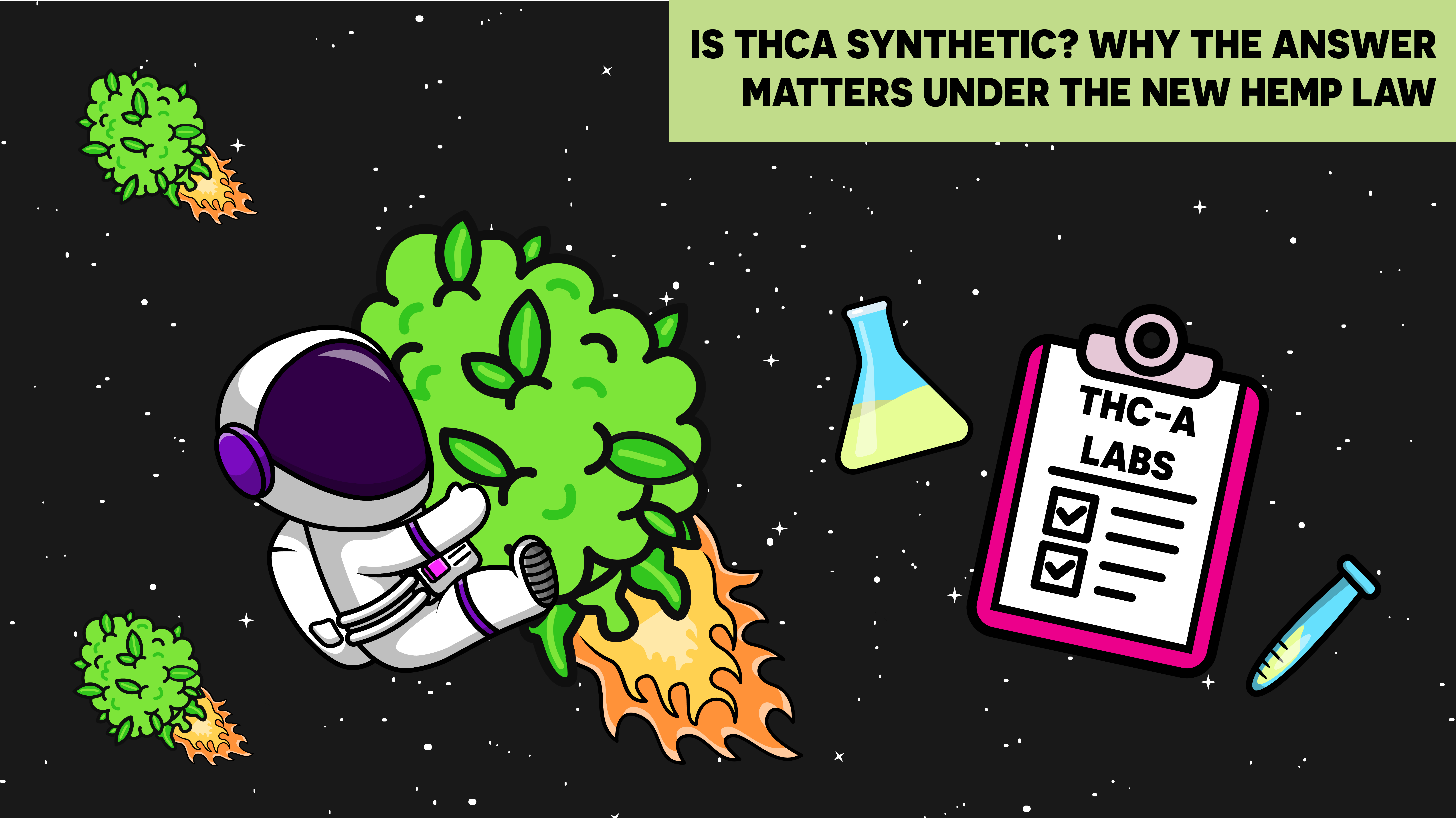
Is THCA synthetic? No. THCA (tetrahydrocannabinolic acid) is made naturally by the cannabis plant, inside the tiny resin glands on its flowers and leaves. It is the plant’s own precursor to delta-9 THC. That puts it in a different legal category from compounds such as delta-8 made from CBD or HHC.
The distinction now has legal weight: Section 781 of Division B of Pub. L. 119-37 treats natural and synthesized cannabinoids differently. For background on how THCA compares with THC, see THC vs THCA: the differences.
Status as of October 12, 2026: Under Pub. L. 119-37, Sec. 781 and H.R. 6500, products with cannabinoids the plant cannot naturally produce lose hemp status on November 12, 2026. Products with natural cannabinoids synthesized outside the plant, and the total THC limit that counts THCA, take effect December 11, 2026.
Is THCA synthetic or natural?
THCA is natural. Cannabis produces it through an enzyme called THCA synthase, which turns a precursor compound, cannabigerolic acid (CBGA), into THCA. Researchers have shown this enzyme works in the glandular trichomes, the resin heads on the flower. No lab step is involved in the plant making THCA.
A 2016 review in Cannabis and Cannabinoid Research notes that THCA builds up in those trichomes and can make up as much as 90% of the total THC in the plant. Over time, and faster with heat, THCA changes into delta-9 THC, a process chemists call decarboxylation.
That heat-driven change is why the law now counts THCA as part of total THC. It does not make THCA synthetic.
What is THCA flower?
THCA flower is dried cannabis flower that tests low in delta-9 THC but high in THCA. Under the 2018 Farm Bill test, which measured only delta-9 THC, it could be sold as hemp. From December 11, 2026, the federal test counts THCA in total THC, so most THCA flower will no longer qualify.
Labs typically report total THC as delta-9 THC plus 0.877 times THCA, the 0.877 reflecting the weight lost when THCA becomes THC. Our guide to reading a lab report shows where these numbers appear on a certificate of analysis.
Is THCA real weed?
Botanically, yes. THCA flower and state-legal marijuana come from the same species, Cannabis sativa L. The difference is legal, not botanical: federal law draws the hemp line by THC concentration. See THCA flower vs THC flower for more.
What does “synthesized” mean under the new hemp law?
The law creates two separate exclusions. One covers cannabinoids that are “not capable of being naturally produced” by the cannabis plant. The other covers cannabinoids the plant can produce but that “were synthesized or manufactured outside the plant.” A product with either type is not hemp under the new definition.
Under Section 2019 of H.R. 6500, signed September 2, 2026, the first exclusion applies from November 12, 2026. The second waits until December 11, 2026, along with the rest of the definition. THCA that the plant made itself fits neither exclusion. It is regulated through the total THC limit instead.
| Compound | How it is commonly described | Category under Sec. 781 | Federal date |
|---|---|---|---|
| THCA in flower | Made by the plant in its trichomes | Natural; counted in total THC | December 11, 2026 (0.3% total THC and 0.4 mg per container limits) |
| Delta-9 THC | Made by the plant, mainly from THCA | Natural; counted in total THC | December 11, 2026 |
| Delta-8 THC made from CBD | Natural only in small amounts; products usually made from hemp CBD | Naturally producible but synthesized outside the plant | December 11, 2026 |
| HHC | Cited by legal analysts as a compound the plant cannot produce | Not capable of being naturally produced | November 12, 2026 |
The table reflects how legal analysts read the statute. FDA was required to publish lists of naturally producible cannabinoids and had not done so as of September 28, 2026, according to the Congressional Research Service (CRS). Those lists could settle borderline cases.
Why does delta-8 made from CBD count as synthesized?
Delta-8 THC is a natural cannabinoid, but FDA says the plant makes it only in small amounts. Most delta-8 products are therefore made from hemp-derived CBD through a chemical conversion outside the plant. That origin, not the molecule itself, is what places it in the “synthesized or manufactured outside the plant” exclusion.
Frier Levitt gives delta-8 produced from CBD as its example of this category. Because it is a naturally producible cannabinoid, it falls under the December 11 clause rather than the November 12 one.
Texas reached a similar result through state rules: reinstated definitions effective July 31, 2026 place delta-8 derived from CBD, along with HHC and THC-O, within its controlled substances framework.
Why does HHC count differently?
HHC (hexahydrocannabinol) is given by Frier Levitt and Cannabis Business Times as an example of a cannabinoid the plant cannot naturally produce. Compounds in that category fall under the first exclusion, which H.R. 6500 left on the original November 12, 2026 schedule.
Federal regulators had already drawn a similar line. In a February 2023 letter, DEA said delta-8 THCO and delta-9 THCO do not occur naturally in cannabis, can only be obtained synthetically, and so do not qualify as hemp. Whether a given compound is “capable of being naturally produced” is ultimately a factual question that FDA’s lists are meant to address.
Can you fail a drug test with THCA?
Standard drug tests look for a THC metabolite, not for whether a product was sold as hemp. Under Department of Transportation (DOT) rules, urine tests screen for marijuana metabolites at 50 ng/mL and confirm at 15 ng/mL. DOT says a product’s hemp or CBD label does not change how a positive result is treated.
One naming trap: DOT rules abbreviate the confirmed metabolite as “THCA,” but HHS names that analyte delta-9-tetrahydrocannabinol-9-carboxylic acid, a THC metabolite, not the plant’s tetrahydrocannabinolic acid. For detection windows, see does THCA stay in your system?
Frequently Asked Questions
Is delta-8 synthetic?
Delta-8 itself occurs in cannabis, but only in small amounts, according to FDA. Most delta-8 products are made from hemp-derived CBD, which is why legal analysts place them in the federal exclusion for cannabinoids synthesized outside the plant, effective December 11, 2026.
Does THCA become illegal because it is synthetic?
No. Natural THCA is not covered by the synthesized-cannabinoid exclusions. It is affected by the total THC limit, which counts THCA toward the 0.3% dry-weight cap and the 0.4 mg per container cap for final products from December 11, 2026.
Who decides which cannabinoids are natural?
The statute directs FDA to publish lists of cannabinoids capable of being naturally produced by the plant and of THC-class cannabinoids. Until those lists appear, legal analysts rely on the statutory wording and scientific literature. Products discussed on this site are for adults 21 and over.
Is THCA synthetic? Not when the plant makes it, and that is why it sits in a different legal category from delta-8 made from CBD or HHC. This article is general information, not legal advice. For decisions about a business or a specific product, speak with a lawyer licensed in your state.
Sources
- 7 U.S.C. 1639o, definitions, with amendment by Pub. L. 119-37, Div. B, Sec. 781 (Cornell LII)
- H.R. 6500, Continuing Appropriations and Extensions Act, 2027, enrolled text, Sec. 2019 (GovInfo)
- Sirikantaramas et al., THCA synthase is secreted into the storage cavity of the glandular trichomes, Plant and Cell Physiology, 2005 (PubMed)
- Shoyama et al., Structure and function of THCA synthase, Journal of Molecular Biology, 2012 (PubMed)
- Moreno-Sanz, Critical review of tetrahydrocannabinolic acid A, Cannabis and Cannabinoid Research, 2016 (PubMed)
- 5 Things to Know about Delta-8 Tetrahydrocannabinol (FDA)
- Changes to the Statutory Definition of Hemp and Implications for Agricultural Policy, September 28, 2026 (Congressional Research Service)
- 49 CFR 40.85, drugs and cutoff concentrations (eCFR)
- DOT CBD Notice (U.S. Department of Transportation)
- Mandatory Guidelines for Federal Workplace Drug Testing Programs, Authorized Testing Panels, March 13, 2026 (HHS, SAMHSA, Federal Register)
- THCA Flower vs. Licensed Cannabis: What’s Legal in 2026? (Howard Law Group, February 23, 2026)
- Federal Hemp Redefinition 2026: THC Limits and Compliance (Frier Levitt)
- DEA Finds that Lab-Derived Cannabis Compounds Are a Schedule I Drug, Even if Made from Hemp (Duane Morris, February 16, 2023)
- Overview of Texas consumable hemp rules (Vicente LLP, August 20, 2026)