



Does THCA Stay in Your System?
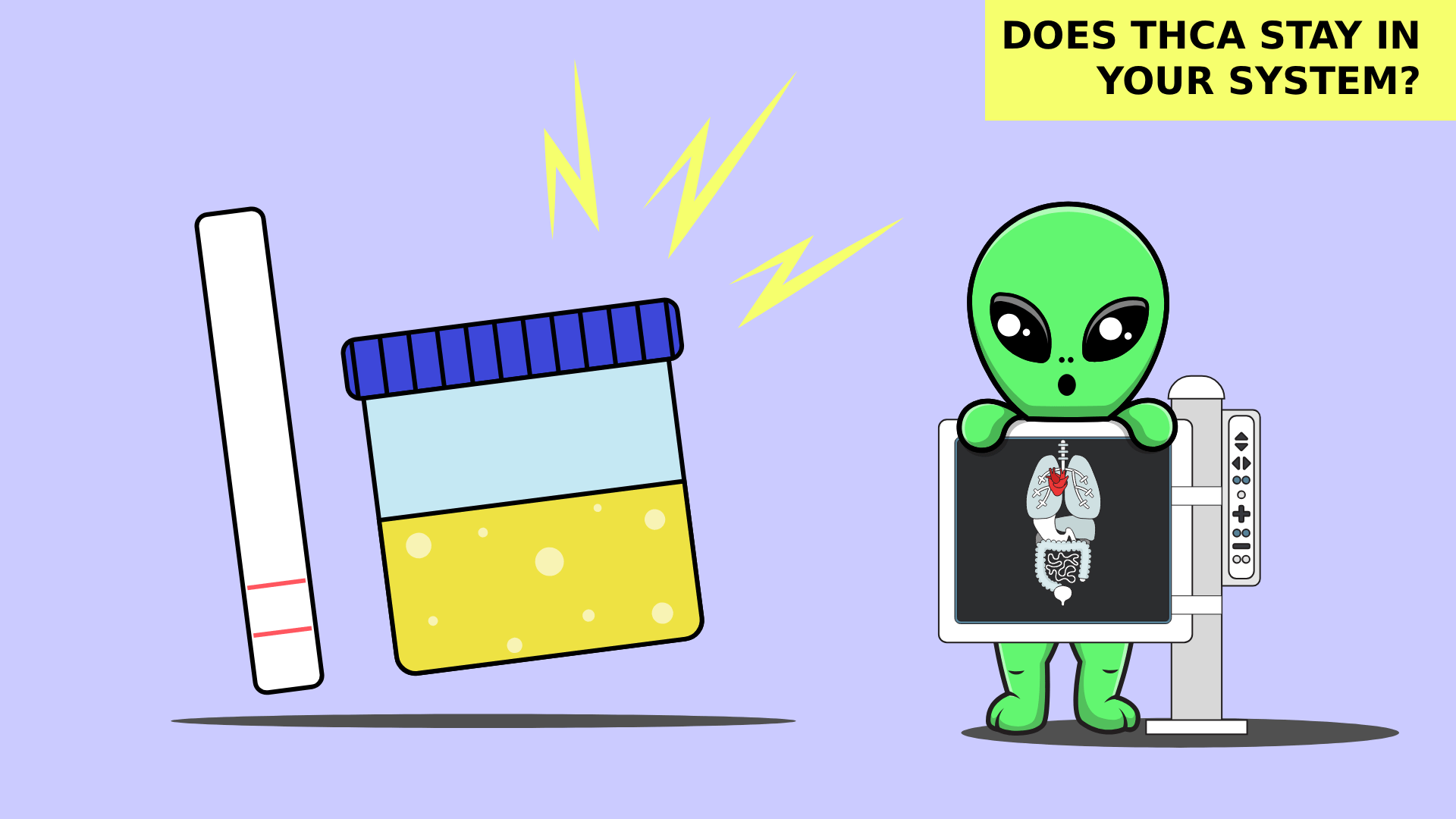
With THCA products gaining serious popularity, one big question keeps coming up: Will it show up on a drug test?
On the surface, THCA seems like a safe option. It’s non-psychoactive in its raw form and technically different from THC. But how it’s processed, how your body handles it, and how modern drug tests work, all of that makes it intriguing.
This guide breaks down what really happens when you consume THCA, how it interacts with your body, and what that means for detection windows across different types of drug tests.
Does THCA Show Up on a Drug Test?
Most drug tests are designed to catch THC metabolites, specifically one called THC-COOH. That’s what your body creates after it breaks down THC. THCA, on the other hand, isn’t psychoactive and doesn’t usually metabolize into THC-COOH on its own. It’s the moment when you light up, vape, or even bake THCA; it turns into THC through a process called decarboxylation. So if you’re using THCA in a way that involves heat, you’re basically consuming THC, and yes, that’ll likely show up on a test.
Even products labeled hemp-derived or under 0.3% THC can still carry small amounts of actual THC. Using enough of them regularly and that trace THC can add up, especially in your fat cells. While THCA doesn’t turn into THC in your body the same way it does with heat, small amounts might convert during digestion or oxidation, which is not common but not impossible either.
Which Drug Tests Can Actually Pick This Up?
Urine tests (most common): These look for THC-COOH. If you’ve consumed THCA that’s been decarbed (even slightly), there’s a good chance you’ll test positive, especially if you’ve been using it regularly.
Blood tests: These look for active THC, not metabolites. The detection window is shorter, usually a day or two for occasional users and longer for heavy users. Raw THCA won’t usually trigger anything unless it’s been heated beforehand.
Saliva tests: These tests are for actual THC, too, not its by products.
Hair tests: Longest window of all. These pick up THC metabolites stored in hair strands over time. THCA itself doesn’t really show up here unless it was converted into THC first.
How Long Does THCA Stay in Your Urine?
For Light or One-Time Use
- Around 3 days at standard test sensitivity.
- Up to 7 days if the test is more sensitive.
- If it’s THCA that was converted and used just once, 3–5 days is a good estimate.
For Moderate Use (A few times a week)
- 10–15 days is a general rule of thumb.
- But if you’re a regular and your test is more sensitive, you might be in the up to 30 days zone.
For Heavy, Chronic Use (Multiple times daily)
- You could be looking at 30 to 60+ days.
- In rare, extreme cases, some studies have seen metabolites sticking around the past 45 days.
For most people, the range is between 1 and 30 days, but if you’re a heavy user, don’t be surprised if it stretches beyond that.
How Long Does THCA Stay in Your Hair?
Once THC is in your bloodstream, its metabolites make their way into your hair follicles via tiny blood vessels. It also sneaks in through sebum and sweat, essentially embedding itself inside the hair shaft as your hair grows. Most tests analyze the first 1.5 inches of hair, which represents about three months of growth. If they’re testing body hair (which grows slower), the detection window might stretch even longer.
General Rule of Thumb: Hair tests can pick up THC use for up to 90 days.
Occasional Users: THC could still be detectable for 30 to 90 days.
Frequent/Heavy Users: If you’re a regular user, you could be flagged for 90+ days.
Hair testing is designed to detect what’s inside the hair, not just what’s sitting on top of it, to avoid false positives from secondhand smoke.
How Long Does THCA Stay in Your Saliva?
Compared to blood or urine, saliva has a short memory. But short doesn’t mean safe, especially if you’ve recently consumed.
Occasional Users: For light users, THC may stick around for 24 to 72 hours, though some studies say 1 to 3 days is more common.
Frequent Users: If you’re lighting up more regularly, saliva tests might catch THC up to 7 days post-use. Some reports show detection up to 30–44 hours, depending on whether the THC was inhaled or ingested.
Anywhere from 2 hours to a full week, depending on how much and how often you use it. Now, while standard saliva tests aren’t tuned to detect THCA directly, some highly sensitive lab tests can pick up traces of unconverted THCA.
How Long Does THCA Stay in Your Blood?
Can blood tests detect THCA directly? Surprisingly, yes, but not always. High-sensitivity lab tests can pick up unconverted THCA in the bloodstream. According to research, THCA can show up within 30 minutes of consumption and stick around for up to 24 hours. That applies whether you’re using a water-based tincture or an oil-based product.
Some studies even found THCA levels as high as 14.8 ng/mL shortly after use, with the THCA/THC ratio reaching up to 18.6%. But THCA doesn’t easily convert to THC inside your bloodstream, so the chance of failing a drug test from raw THCA alone is pretty low. Here’s a rough timeline of how long THC (from converted THCA) sticks around in blood:
General presence: 12–24 hours after use
Occasional users: 1–2 days
Frequent users: 3–7 days, sometimes longer
Heavy users: THC might still be detectable for 7–14 days, with rare cases pushing up to 30 days
The elimination half-life of THC in blood serum is about 1.4 hours, but its metabolites (like THC-OH and THC-COOH) last 2 to 3.4 hours. In terms of full elimination, the plasma half-life can stretch from 1–3 days in light users to 5–13 days in chronic users.
What Factors Affect the Detection Window of THCA in Your Body?
When the body metabolizes THCA like any other form of cannabis, several personal and situational factors can influence how long that stays detectable.
- Frequency & Dosage – More frequent use (even of low-THC products) means more accumulation. Occasional users flush it faster; daily users don’t.
- Metabolism & Body Composition – Faster metabolisms clear THC quicker. THC is fat-soluble, so people with higher body fat can retain it longer.
- Hydration & Physical Activity – Staying hydrated and regularly exercising may help support elimination, but short-term effects (working out right before a test) can backfire.
- Product Purity & Storage – Even compliant THCA products (<0.3% THC) can carry trace THC, especially if degraded over time or stored poorly. Regular use of these can add up.
- Test Type & Sensitivity – Urine, blood, saliva, hair, and breath tests all have different windows. The lower the test’s detection threshold, the longer THC sticks around.
Can Breath Tests Detect THCA?
Breath tests don’t detect THCA; they’re built to catch active THC, and only for a short window. If you’ve smoked or vaped THCA, it can show up on these tests within 30 minutes to 3 hours. But if you’re consuming raw, unheated THCA tablets it’s highly unlikely to trigger a positive result since no significant THC is present in your breath.
Where Can I Get THCA Products From?
So when people ask how to get THCA out of their system fast, there’s no shortcut. No tea, no powder, no secret cleanse that’ll magically wipe it away overnight. Your body needs time. Staying hydrated helps. Moving your body helps. But nothing replaces simply pausing consumption and letting your system clear out naturally.
If you’re still interested in the benefits of THCA, like mood support and inflammation relief, there are ways to use it without crossing that psychoactive threshold. Unheated forms, like THCA gummies or other lab tested products, let you tap into its potential while avoiding full-on conversion to THC.
We understand that balance matters. That’s why we offer a range of THCA options designed to fit different needs and lifestyles.