

Is THCA Being Banned? What December 11, 2026 Means for THCA Flower
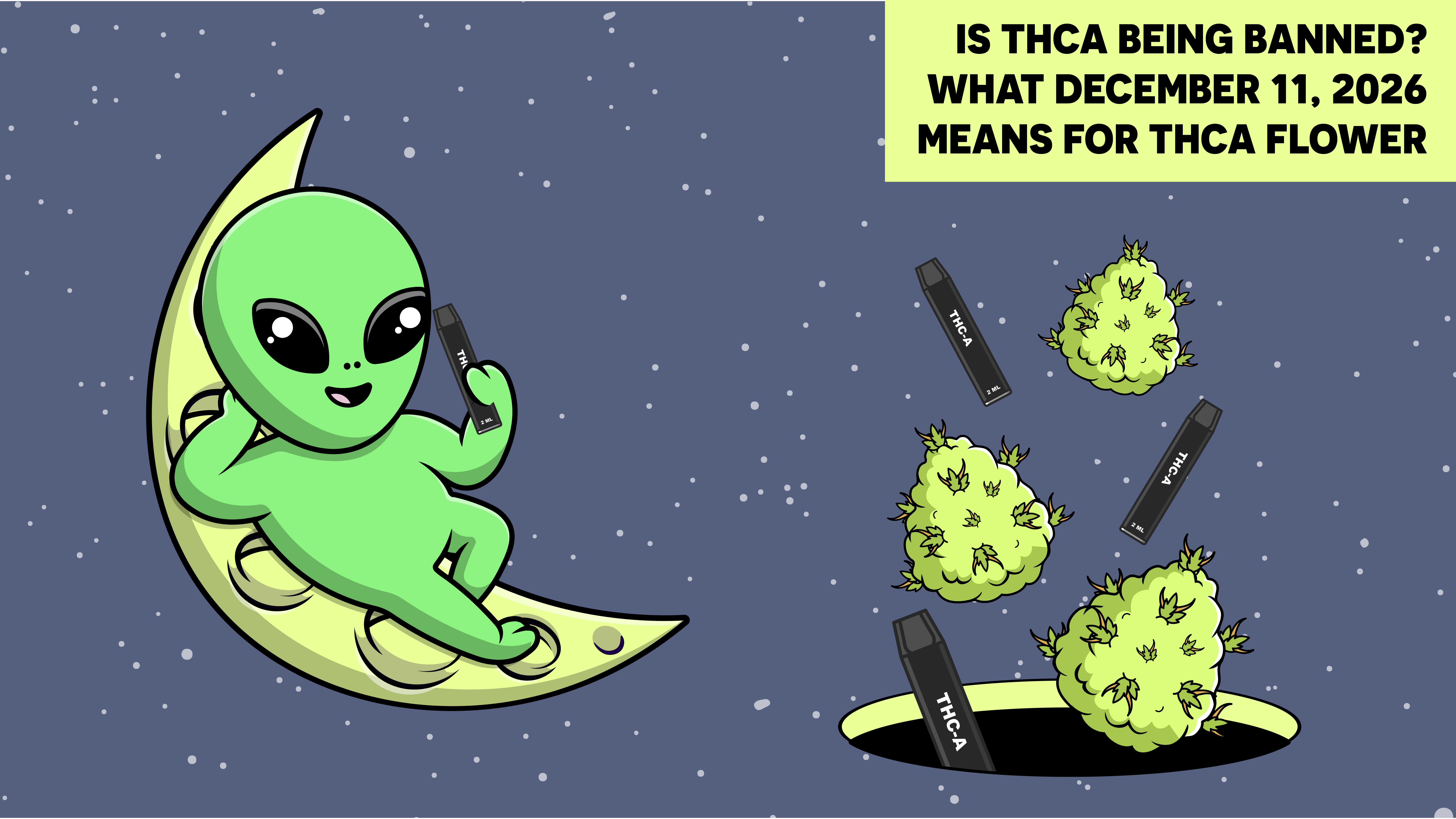
Is THCA being banned? At the federal level, mostly yes for THCA flower as it is sold today. From December 11, 2026, the federal definition of hemp counts THCA toward a 0.3% total THC limit, so high-THCA flower stops qualifying as hemp and would be treated as marijuana under federal law.
The change comes from Section 781 of Division B of Pub. L. 119-37, signed November 12, 2025. Several states moved first, and our THCA 50-state legal guide tracks those rules. This page covers the federal timeline, the date change and the bills still in play.
Status as of October 12, 2026: Most of the federal hemp redefinition in Pub. L. 119-37 takes effect December 11, 2026, after H.R. 6500 moved it from November 12. Cannabinoids the plant cannot naturally produce lose hemp status on November 12, 2026. Pending bills could still change the outcome.
Is THCA being banned? The short answer
THCA is not being added to a federal drug schedule by name. What changes is the definition of hemp. After December 11, 2026, hemp must stay at or under 0.3% total THC, with THCA counted in. THCA flower is sold for its high THCA content, so most of it falls outside that definition.
Federal drug law excludes hemp, as defined in 7 U.S.C. 1639o, from the definition of marijuana. Anything that no longer meets the hemp definition loses that exclusion. The Congressional Research Service (CRS) notes that excluded products would be regulated under the Controlled Substances Act as marijuana.
What the 2025 federal hemp law changed
The 2018 Farm Bill defined hemp by delta-9 THC alone. Section 781, part of the funding package that ended the 43-day government shutdown in November 2025, replaces that test with total THC, explicitly including THCA, and caps final consumer products at 0.4 mg total THC per container. Its main parts are:
- A 0.3% total THC limit, including THCA, on a dry-weight basis.
- Exclusion of products with cannabinoids that cannot be naturally produced by a Cannabis sativa L. plant.
- Exclusion of products with naturally producible cannabinoids that were synthesized or manufactured outside the plant.
- A 0.3% combined limit for intermediate products and a 0.4 mg per container limit for final products.
- A protected category of industrial hemp grown for fiber, grain, seed oil, microgreens or research.
The law also told FDA to publish, within 90 days, lists of naturally occurring cannabinoids and THC-class cannabinoids, plus guidance on the term “container.” CRS reported on September 28, 2026 that those lists had not yet been published.
Why the date moved from November 12 to December 11
Congress passed H.R. 6500, the Continuing Appropriations and Extensions Act, 2027, and the President signed it on September 2, 2026. Section 2019 of that law says that until December 11, 2026, the hemp amendments apply only to products containing cannabinoids the plant cannot naturally produce. Everything else waits until December 11.
The Senate passed the bill 90 to 6 and the House 370 to 48. December 11 is also when the stopgap funding runs out. The bill is now Public Law 119-103.
Foley Hoag and Marijuana Moment reported that White House legislative affairs director James Braid told Senate Republicans there would be no further extensions. That was a reported commitment, not a statute.
What counts as total THC under the new definition?
Total THC means all tetrahydrocannabinols, with tetrahydrocannabinolic acid (THCA) expressly included, measured on a dry-weight basis. The limit for plants and intermediate materials is 0.3%. Final consumer products may hold no more than 0.4 mg combined total THC, plus other THC-like cannabinoids, per container.
The statute defines a container as the innermost packaging in direct contact with the product for retail sale, such as a jar, bag, can or cartridge.
Labs testing for federally licensed hemp growers already add delta-9 THC to THCA multiplied by 0.877, which reflects the weight THCA loses when it converts to THC. For a deeper look at the two compounds, see THCA flower vs THC flower.
What happens to THCA flower, vapes and edibles?
From December 11, 2026, a THCA product counts as federal hemp only if it meets the new limits. Plant material must test at or under 0.3% total THC, and final products must contain no more than 0.4 mg total THC per container. Products over those limits would be treated as marijuana under federal law.
| Product type | Federal test before December 11, 2026 | Federal test from December 11, 2026 |
|---|---|---|
| THCA flower and pre-rolls | Delta-9 THC at or under 0.3%; THCA not counted | Total THC, including THCA, at or under 0.3%; final products also face the 0.4 mg per container cap |
| THCA vapes and concentrates | Delta-9 THC at or under 0.3% | No more than 0.4 mg total THC per container |
| Edibles and drinks | Delta-9 THC at or under 0.3% by weight | No more than 0.4 mg total THC per container |
| Cannabinoids the plant cannot naturally produce | Not addressed by name | Excluded from hemp from November 12, 2026 |
| Industrial hemp (fiber, grain, seed oil) | Hemp | Still hemp |
How regulators will apply the container cap to packaged flower is not yet settled, because FDA guidance on “container” is still outstanding. Hemp products discussed on this site are intended for adults 21 and over.
What states banned THCA already?
Several states restricted THCA before the federal change. Alabama banned smokable hemp products from July 1, 2025. Tennessee ended THCA flower sales on July 1, 2026. Texas rules count THCA toward total THC, although lawsuits continue. Idaho and Washington also restrict it. State rules shift often, so confirm current law.
- Alabama: HB 445 created a ban on smokable hemp products, effective July 1, 2025, according to Alabama Reporter coverage.
- Tennessee: Under HB 1376, THCA flower and other high-THCA hemp products could no longer be sold from July 1, 2026, and sales are limited to 21-and-over venues.
- Texas: State health department rules count 87.7% of THCA toward the delta-9 limit, which makes high-THCA flower noncompliant for sale. Enforcement varies by agency, as KUT reported in September 2026.
For state-by-state detail, see our guides to THCA law in Texas and THCA law in Georgia.
Could smokable THC be legal in Texas again?
That depends on the courts and the Legislature. A Texas appeals court let the health department’s rules take effect again in June 2026, cases continue in state and federal court, and lawmakers next meet in 2027. The federal change applies regardless.
Is THCA still going to be banned? Bills that could change the outcome
It may not be, if Congress acts before December 11. Bills introduced in the 119th Congress would delay the date, repeal the change or replace it with a regulated market. None of the delay or repeal bills had become law as of October 12, 2026, so the current schedule still stands.
The main proposals named by CRS and law firm trackers are:
- H.R. 7024, Hemp Planting Predictability Act: Introduced January 13, 2026 by Rep. Baird. It would change the 365-day delay in Section 781 to three years.
- H.R. 7010 and S. 3686: Listed by CRS as two-year delay bills.
- H.R. 6209, American Hemp Protection Act: Would repeal Section 781 and restore the 2018 definition.
- H.R. 7212, H.R. 10079, S. 3474 and Rep. Barr’s proposal: Would create federal rules for hemp cannabinoid products instead of excluding them, such as age limits and labeling.
Any of these would need to pass both chambers and be signed before the December deadline.
How to follow THCA status after December 11
Watch three things: whether Congress passes a delay or a regulatory bill, whether FDA publishes its cannabinoid lists and container guidance, and what your state does next. Congress.gov, the Federal Register and your state agency are more reliable than vendor summaries.
Check the date on any article about THCA law, including this one. Much of what ranks today was written for the original November 12 date. We plan to update this page on or after December 11, 2026.
Frequently Asked Questions
Is THCA federally legal right now?
Until December 11, 2026, the federal hemp definition still measures delta-9 THC, not THCA, for most products. That is how THCA flower has been sold as hemp. Products with cannabinoids the plant cannot naturally produce are excluded from November 12, 2026. State law may be stricter.
How is THCA legal under the old rules?
The 2018 Farm Bill limited only delta-9 THC to 0.3% by dry weight. THCA is a different molecule until it is heated, so flower high in THCA could pass a delta-9 test. Section 781 closes that gap by counting THCA in total THC.
Why is THCA banned?
CRS explains that delta-9 is not the only potentially intoxicating THC in the plant, and the old test ignored THCA, which converts to THC when heated. Congress switched to a total THC standard to close that gap. A bipartisan group of 35 state and territory attorneys general urged Congress to keep the change.
Will THCA be banned in every state?
The federal definition applies nationwide, but states with licensed marijuana programs can still allow cannabis products, including high-THCA flower, through their own licensed systems. Those products are regulated as marijuana under state law, not sold as federal hemp.
The bottom line: is THCA being banned? Federally, THCA flower sold as hemp loses that status on December 11, 2026, unless Congress changes course first. This article is general information, not legal advice. For decisions about a business or a specific product, speak with a lawyer licensed in your state.
Sources
- 7 U.S.C. 1639o, definitions, with amendment by Pub. L. 119-37, Div. B, Sec. 781 (Cornell LII)
- H.R. 6500, Continuing Appropriations and Extensions Act, 2027, enrolled text, Sec. 2019 (GovInfo)
- Congressional Bill H.R. 6500 Signed into Law (The White House)
- Changes to the Statutory Definition of Hemp and Implications for Agricultural Policy, September 28, 2026 (Congressional Research Service)
- H.R. 7024, Hemp Planting Predictability Act (Congress.gov)
- 21 U.S.C. 802, definitions of marijuana (Cornell LII)
- A Temporary Reprieve for Hemp THC Products, But What Now? (Foley Hoag, September 15, 2026)
- House Passes Bill to Delay Hemp THC Product Ban (Marijuana Moment, September 1, 2026)
- Texas THCA hemp flower and concentrate legal status (KUT, September 15, 2026)
- Sweeping changes coming to TN hemp industry on July 1 (The Lynchburg Times, June 4, 2026)
- Cannabis coalition warns of crackdowns as HB 445 takes effect (Alabama Reporter)
- THCA Flower vs. Licensed Cannabis: What’s Legal in 2026? (Howard Law Group, February 23, 2026)
- Industry stakeholders react to Trump-signed federal hemp product ban (Cannabis Business Times, November 13, 2025)