



7-OH vs Pseudo vs MGM-15: The Kratom Alkaloid Comparison
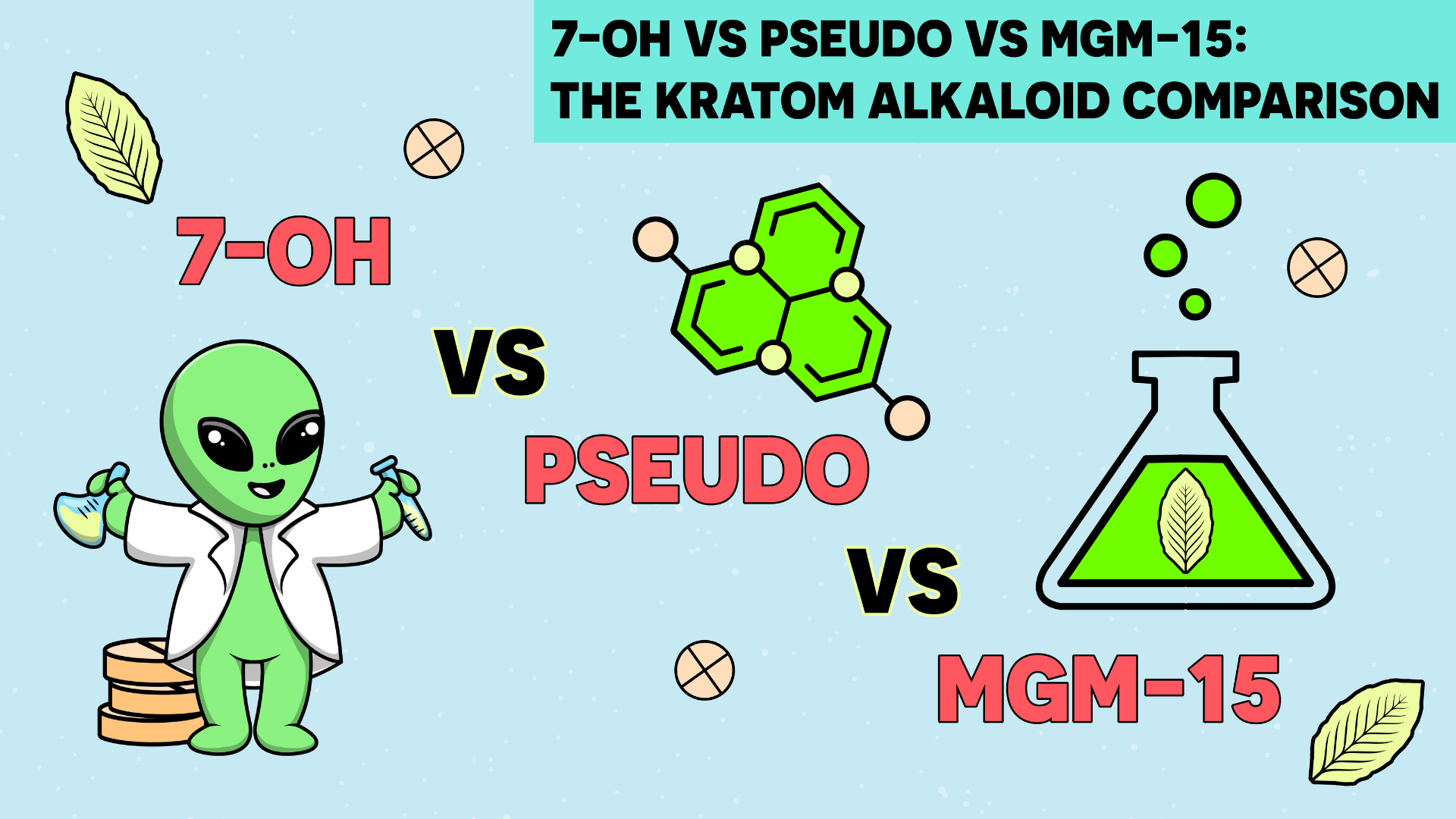
Several compounds that were marketed alongside kratom are now under federal action, but they are not all in the same legal position. Some are already Schedule I. One is the subject of a pending notice. Kratom leaf itself is not federally controlled.
This page puts them side by side, with the federal position and the state position kept separate, so you can see exactly where each one stands as of October 21, 2026.
The short answer
- Already Schedule I: mitragynine pseudoindoxyl (“Pseudo”), MGM-15, MGM-16 and SR-17018.
- Pending: concentrated 7-OH. DEA has proposed temporary Schedule I control, and an order can publish on or after November 13, 2026.
- Not federally controlled: kratom leaf and mitragynine, though FDA does not treat kratom as a lawful supplement and several states ban it.
Federal status side by side
| Compound | Also called | Federal status | Since | What comes next | Source |
|---|---|---|---|---|---|
| Mitragynine pseudoindoxyl (MGPI) | Pseudo | Temporary Schedule I at any amount | August 26, 2026 | Threshold proposed October 14, 2026 | FR 2026-17429, FR 2026-20943 |
| MGM-15 | Dihydro-7-OH | Temporary Schedule I | August 26, 2026 | Notice reissued October 14, 2026, no change | FR 2026-17429, FR 2026-20942 |
| MGM-16 | Fluoro-dihydro-7-OH | Temporary Schedule I | August 26, 2026 | Same as MGM-15 | FR 2026-17429, FR 2026-20942 |
| SR-17018 | SR-17 | Temporary Schedule I | August 27, 2026 | Order runs to August 27, 2028 | FR 2026-17531 |
| 7-hydroxymitragynine (concentrated) | 7-OH | Not yet scheduled; notice of intent pending | Notice October 14, 2026 | Order can publish on or after November 13, 2026 | FR 2026-20943 |
| Mitragynine and kratom leaf | Kratom, MIT | Not federally controlled | n/a | Products with a mitragynine to 7-OH ratio below 100 to 1 would be covered by the proposal | FR 2026-20943, FDA and Kratom |
How these compounds relate to each other
Mitragynine is the main alkaloid in kratom leaf. 7-OH also occurs naturally, but DEA says it makes up less than two percent of the plant’s total alkaloid content (FR 2026-20943). Concentrated 7-OH products are made by processing.
MGPI, MGM-15 and MGM-16 are described in the federal order as synthetic derivatives of mitragynine or 7-OH, made by modifying purified alkaloids (FR 2026-17429). They are not kratom leaf.
SR-17018 is not related to kratom at all. It was scheduled in a separate order with three other lab-made compounds (FR 2026-17531).
What changed on October 14, 2026
HHS sent DEA a new recommendation by letter dated October 8, 2026 (FR 2026-20943). DEA then:
- withdrew its July 6, 2026 notice of intent for 7-OH (FR 2026-13580);
- published a new notice covering 7-OH and MGPI together, with thresholds of more than 1 mg per gram for solids, more than 1 mg per milliliter for liquids, or a mitragynine ratio below 100 to 1 (FR 2026-20943);
- reissued the MGM-15 and MGM-16 notice without change (FR 2026-20942).
The Department of Justice summarized both actions (DOJ press release).
What happens on or after November 13, 2026
DEA can publish temporary scheduling orders based on the October notices on or after November 13, 2026. An order takes effect on the day it publishes. For 7-OH, that would make products above the threshold Schedule I. For MGPI, it would replace today’s no-threshold control. For MGM-15 and MGM-16, nothing changes: they stay in Schedule I.
What Schedule I means
Schedule I substances have no currently accepted medical use and a high potential for abuse (DEA: Drug Scheduling). Making, selling or possessing them outside DEA-registered research is a federal offense (21 U.S.C. 841; 21 U.S.C. 844). A temporary order lasts two years and can be extended by one year (21 U.S.C. 811).
State rules that apply now
State law can be stricter than federal law, and for 7-OH it already is in many places:
- The DEA notice lists these states as prohibiting 7-OH: Alabama, Arkansas, Connecticut, Indiana, Kansas, Louisiana, Massachusetts, Tennessee, Vermont and Wisconsin (FR 2026-20943).
- Florida restricted 7-OH in August 2025 (FDA statement) and added seven related compounds, including MGPI and MGM-15, to its Schedule I by emergency rule on June 22, 2026 (Florida Phoenix).
- California’s health department says kratom and 7-OH products may not be sold in the state (CDPH).
- Utah’s agriculture department says the state banned kratom products other than pure leaf during the 2026 legislative session (Utah Department of Agriculture and Food).
- Some states ban kratom itself. Kansas made kratom and all of its derivatives, including 7-OH, illegal from July 1, 2026 (KSHB).
For the full state table, see 7-OH legal status by state.
FDA’s position
FDA’s position is that 7-OH does not meet the definition of a drug, dietary supplement or dietary ingredient, and that no food additive regulation allows its use (FDA). FDA also treats kratom as an adulterated dietary supplement and an unsafe food additive (FDA and Kratom).
Frequently asked questions
Which of these compounds is legal right now?
Under federal law, MGPI, MGM-15, MGM-16 and SR-17018 are Schedule I. Concentrated 7-OH is not yet scheduled but has a pending DEA notice, and FDA considers it unlawful in supplements and food (FDA). Kratom leaf is not federally controlled. State law may prohibit any of them.
Is Pseudo stronger or safer than 7-OH?
This page covers legal status only. Federal agencies have not found any of these compounds safe, and DEA says no one should infer that products below its proposed threshold are safe (FR 2026-20943).
Will 7-OH become Schedule I?
DEA has proposed temporary Schedule I control of 7-OH above a threshold. No order has been issued. One can publish on or after November 13, 2026.
Is kratom leaf affected?
Kratom leaf is not federally controlled. Under the proposal, a product with a mitragynine to 7-OH ratio below 100 to 1 would be covered. DEA says it proposed a threshold because trace amounts can occur in some botanical kratom products, and that products below it should not be assumed safe (FR 2026-20943).
Does Elyxr sell Pseudo, MGM-15, MGM-16 or SR-17?
No.
Where can I check my state?
Start with 7-OH legal status by state, then confirm with your state health or agriculture department.
Related reading
- MGM-15: federal Schedule I status
- Mitragynine pseudoindoxyl (Pseudo): federal status
- SR-17018 (SR-17): federal Schedule I status
- 7-OH federal scheduling: where things stand
- Is 7-OH legal in my state?
Sources
- Federal Register 2026-17429, temporary Schedule I order for MGPI, MGM-15 and MGM-16 (Aug 26, 2026) (checked October 21, 2026)
- Federal Register 2026-20943, DEA notice of intent for 7-OH and MGPI above a threshold (Oct 14, 2026) (checked October 21, 2026)
- Federal Register 2026-20942, DEA notice of intent for MGM-15 and MGM-16 (Oct 14, 2026) (checked October 21, 2026)
- Federal Register 2026-17531, temporary Schedule I order including SR-17018 (Aug 27, 2026) (checked October 21, 2026)
- FDA and Kratom (checked October 21, 2026)
- Federal Register 2026-13580, DEA notice of intent for 7-OH (Jul 6, 2026) (checked October 21, 2026)
- U.S. Department of Justice press release on the 7-OH and related scheduling actions (Oct 2026) (checked October 21, 2026)
- DEA: Drug Scheduling (checked October 21, 2026)
- 21 U.S.C. 841, manufacture and distribution (Cornell LII) (checked October 21, 2026)
- 21 U.S.C. 844, possession (Cornell LII) (checked October 21, 2026)
- 21 U.S.C. 811, temporary scheduling (Cornell LII) (checked October 21, 2026)
- FDA Commissioner statement on Florida’s restriction of 7-OH products (Aug 13, 2025) (checked October 21, 2026)
- Florida Phoenix: Florida emergency rule adds 7-OH related compounds to Schedule I (Jun 22, 2026) (checked October 21, 2026)
- California Department of Public Health NR25-016 on kratom and 7-OH products (Oct 24, 2025; revised Jan 7, 2026) (checked October 21, 2026)
- Utah Department of Agriculture and Food: illegal kratom product sold as cat’s claw (Jul 30, 2026) (checked October 21, 2026)
- KSHB: Kansas ban on kratom and 7-OH takes effect (Jul 1, 2026) (checked October 21, 2026)
- FDA: Hiding in Plain Sight, 7-OH Products (checked October 21, 2026)
This article explains public government records in plain language. It is general information, not legal advice. Laws change quickly in this area, so check the linked sources and your own state’s rules before you act. Last verified: October 21, 2026.