



THCA Gummies: What They Are and How They Work
THCA gummies became one of the most talked-about products in the hemp space over the past few years, largely because of a specific legal argument built around how THC was originally defined under federal hemp law. That argument has now been directly addressed by new legislation, which makes this a good moment to understand exactly what THCA is, how it actually works once it’s in your body, and what’s changed.
What THCA Actually Is
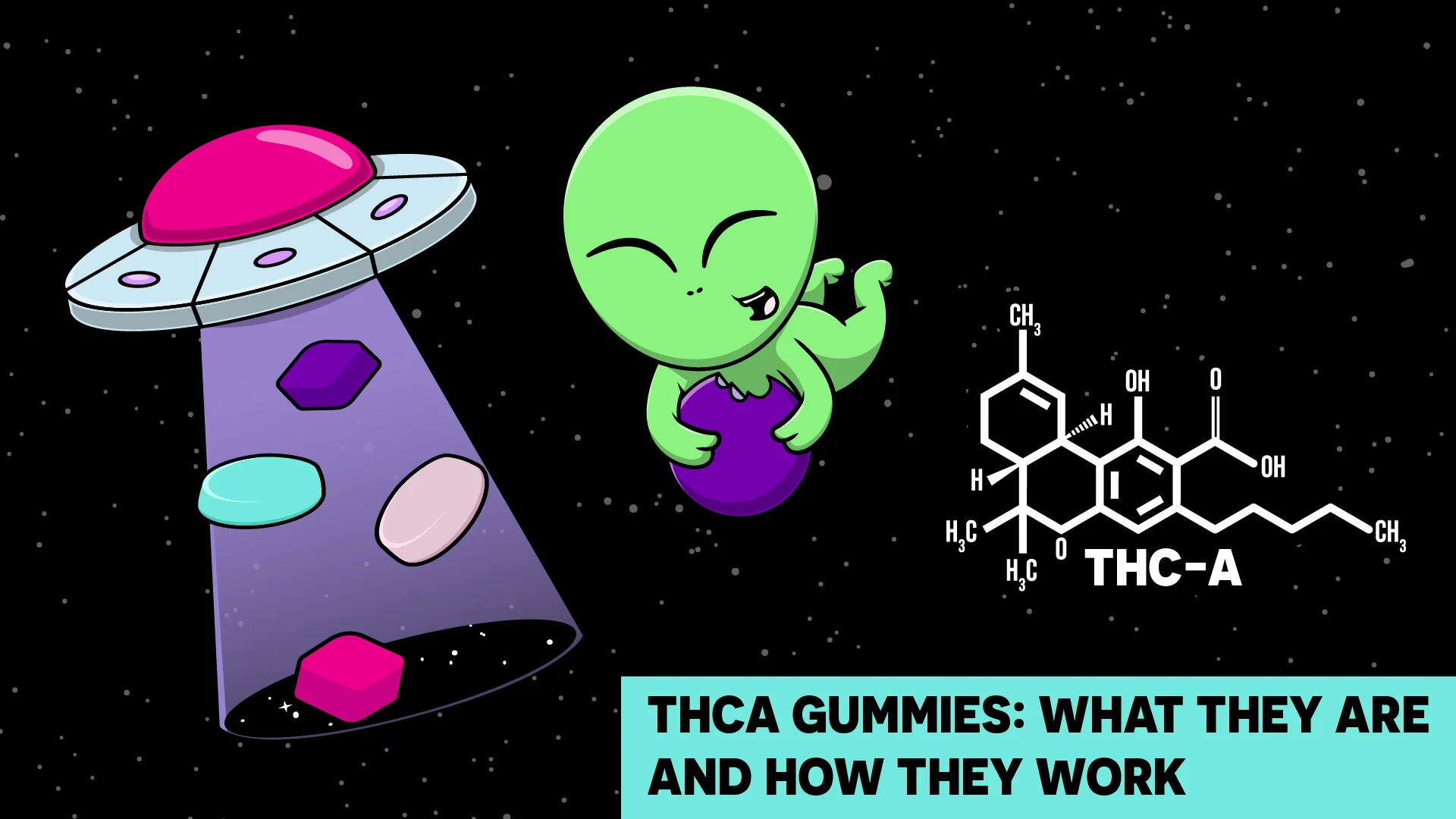
THCA, tetrahydrocannabinolic acid, is the raw, acidic form of THC as it naturally exists in the fresh, unheated cannabis plant. Every cannabis plant produces THCA, not Delta-9 THC directly, and it’s only through a process called decarboxylation, triggered by heat, that THCA converts into the Delta-9 THC responsible for cannabis’s intoxicating effects.
In its raw, unconverted state, THCA does not produce intoxication. This is a real, chemically accurate fact, and it’s the foundation the entire THCA product category was built on.
How THCA Gummies Actually Work
Here’s where the product category gets more complicated than the raw chemistry alone suggests. THCA converts to Delta-9 THC not just through direct heat exposure like smoking or vaping, but also, to a meaningful degree, through your body’s own metabolic and digestive processes once ingested, along with any heat involved during the manufacturing process itself, such as when THCA extract is processed into a gummy.
This means a THCA gummy, despite technically listing THCA rather than Delta-9 THC as its primary cannabinoid, functions as an intoxicating edible in practice. Most users report effects essentially indistinguishable from a standard THC gummy, with onset in the typical forty-five-to-ninety-minute range and effects commonly lasting four to eight hours.
The Legal Argument THCA Products Were Built On
For years, the hemp industry’s legal argument for THCA products rested on a specific technical reading of the 2018 Farm Bill’s hemp definition, which set the legal threshold at 0.3 percent Delta-9 THC specifically, by that exact name, on a dry weight basis. Because THCA is chemically distinct from Delta-9 THC until it converts, some manufacturers and legal advisors argued that a product could contain high levels of THCA, technically compliant with the letter of the Delta-9-specific threshold, while still producing full intoxicating effects once consumed, since conversion happened after the point of sale rather than being measured in the product as sold.
This became widely known as the THCA loophole, and it’s the reason THCA flower and THCA gummies exploded into a massive product category, often marketed at potency levels that would have been clearly illegal if framed as Delta-9 THC directly.
Why That Loophole Just Closed
Federal legislation enacted in late 2025 addressed this directly and specifically. The new hemp definition explicitly folds THCA into the total THC calculation, rather than measuring Delta-9 THC alone. This closes the exact gap the THCA product category was built around, since a product can no longer stay technically compliant by containing high THCA levels while avoiding the Delta-9-specific threshold.
Combined with this change, the broader hemp framework also introduced a maximum limit of 0.4 milligrams of total THC, now including THCA in that total, per container, with compliance required by December 11, 2026. This total-THC-per-container cap is a dramatically stricter standard than the percentage-based threshold THCA products were previously built around, and it applies regardless of whether the THC in question is labeled as THCA or Delta-9.
What This Means for the THCA Product Category
Given how directly and specifically this new law addresses THCA, the product category as it has existed for the past several years is not compatible with the framework taking effect in December 2026. This isn’t a case of ambiguous legal interpretation the way some other cannabinoid questions are. The legislative language specifically named and closed the exact mechanism THCA products relied on.
Products currently marketed as high-potency THCA flower or THCA gummies, often listing THCA percentages in the twenty-to-thirty-percent range, a figure that would translate to a Delta-9-equivalent content wildly beyond the new 0.4-milligram-per-container cap, are facing a fundamental incompatibility with the incoming legal framework, not a minor compliance adjustment.
State-Level Restrictions Were Already a Factor Before This
Even before this federal change, THCA products faced a patchwork of state-level restrictions, since a number of states had already moved to explicitly ban THCA products specifically because state regulators recognized the same conversion argument the federal loophole relied on and decided to close it independently. States including Alabama, Georgia, Idaho, Iowa, New Jersey, Oregon, Rhode Island, Tennessee, and Texas have restricted or excluded THCA products from being sold or shipped, and that list reflects the state of play prior to the federal change discussed above, meaning it’s worth checking current state-specific status separately from the federal timeline.
What to Do If You’re Currently Using THCA Products
If THCA flower or gummies are part of your current routine, this is worth treating as a category in active transition rather than a stable long-term option. Given both the federal deadline and the pattern of state-level restrictions that predates it, the safest assumption going forward is that THCA products as currently formulated and marketed will not remain available in their current form much longer, regardless of which state you’re in.
Why This Case Is a Useful Lesson Beyond THCA Specifically
The THCA situation is worth understanding even if you never personally bought a THCA product, because it’s a clear, well-documented example of how a hemp product category built around a narrow legal technicality can lose that footing quickly once regulators specifically address it. The same pattern, a technical argument for compliance that lawmakers eventually close off directly, is playing out across several other conversion-based and high-potency cannabinoid categories right now, which makes THCA a useful case study for how fast this kind of shift can happen once legislators decide to act on it.
A Few Common Questions
Q. Is THCA itself illegal, or just products marketed around the loophole?
THCA itself isn’t scheduled as a controlled substance, but the new federal hemp definition specifically counts it toward the total THC threshold, which eliminates the practical mechanism that let high-THCA products be sold as legal hemp.
Q. Does heating THCA gummies before eating them change anything?
No, this doesn’t meaningfully change anything from a legal or practical standpoint, since conversion happens through digestion and metabolism regardless, and the product is already formulated and regulated as what it functions as once consumed.
Q. Will THCA products disappear completely, or will reformulated versions exist?
Given the 0.4-milligram-per-container cap now applying to total THC including THCA, any future THCA products remaining compliant with federal hemp law would need to be reformulated at potency levels far below what the category has been known for.
Q. Is THCA flower affected the same way as THCA gummies?
Yes, the total THC calculation and the per-container cap apply to the hemp product category broadly, not just to edibles specifically, meaning THCA flower faces the same fundamental incompatibility with the new framework.
The Bottom Line
THCA gummies were built around a specific, well-understood legal argument: raw THCA isn’t intoxicating until converted, and the old hemp law only measured Delta-9 THC by name. New federal legislation closed that gap directly, folding THCA into the total THC calculation and introducing a strict 0.4-milligram-per-container cap effective December 11, 2026. The chemistry of how THCA converts to THC in your body hasn’t changed, but the legal framework this entire product category depended on has, and it’s changed in a way that specifically and deliberately targeted THCA products by name.