





Functional Mushrooms (Lion’s Mane, Reishi) vs. Amanita: Understanding the Difference
Walk through the mushroom section of a wellness shop or scroll through an online store that sells them, and you’ll often find lion’s mane capsules sitting a few rows away from Amanita muscaria gummies, both labeled with variations of “mushroom” on the front of the package. It’s an easy mix-up to make if you’re new to this space, but these are genuinely different categories of product, built from different species with entirely different mechanisms, and mixing them up in your head can lead to some confusing expectations either way.
Two Completely Different Kinds of Mushrooms
The first thing to understand is that “mushroom” as a category covers an enormous range of species with wildly different properties, in the same way “plant” covers everything from lettuce to tobacco. Lumping them all together because they’re technically fungi tells you almost nothing useful about what a specific product actually does.
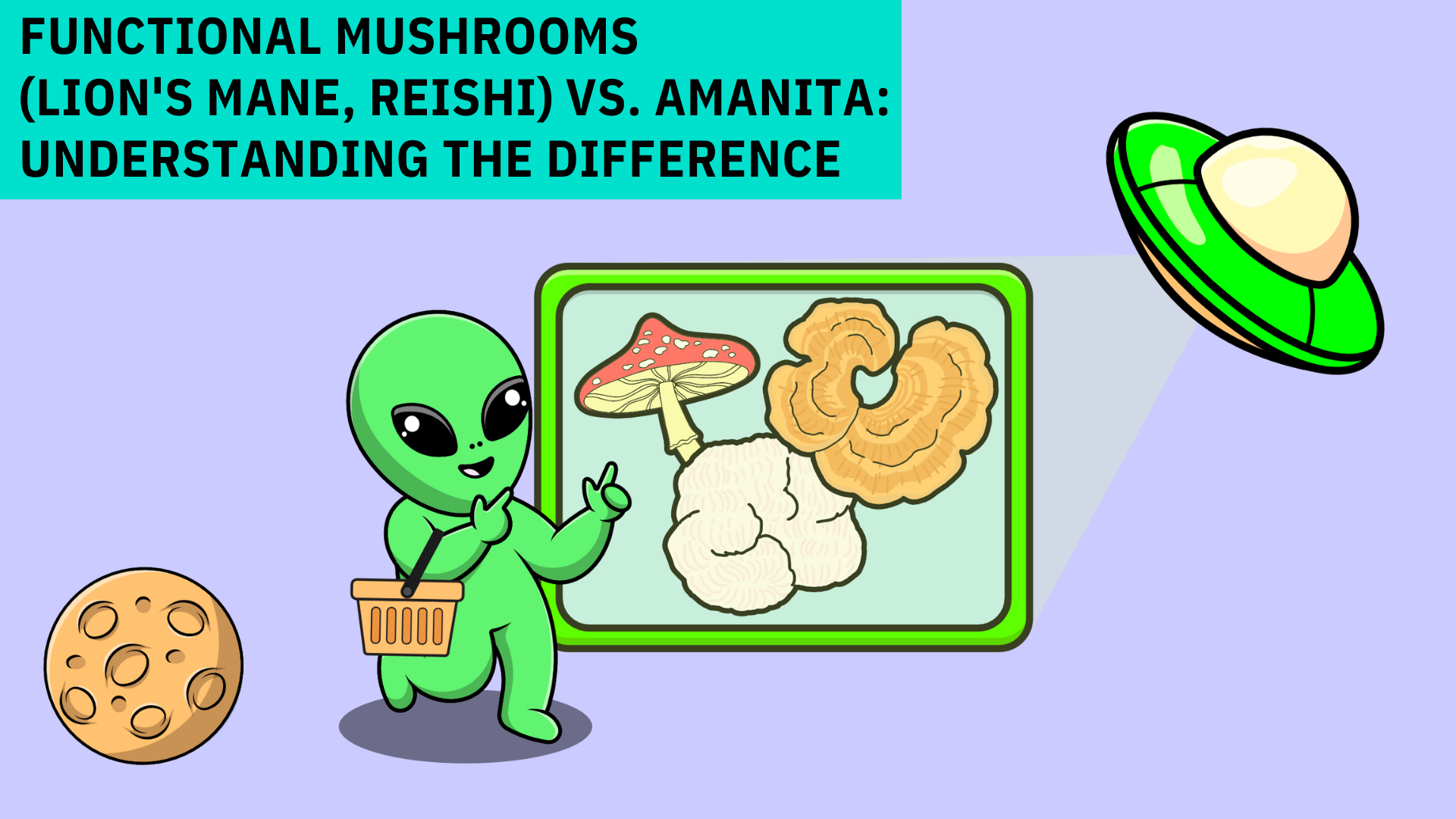
Lion’s mane and reishi belong to a group generally referred to as functional mushrooms. This is a broad category of mushroom species that have been used traditionally and are studied today primarily for their non-psychoactive bioactive compounds, things like beta-glucans, polysaccharides, and antioxidants, rather than for any mind-altering effect. These species are not psychoactive at all. There’s no altered state, no hallucinogenic quality, nothing that would change your perception the way the word “mushroom” sometimes implies in casual conversation.
Amanita muscaria is a completely different species with a completely different chemical profile. It’s known for containing muscimol, a compound that’s explicitly psychoactive, acting on GABA-A receptors in the central nervous system to produce altered sensory perception and other mind-altering effects. This is not a functional mushroom in the same sense as lion’s mane or reishi. It belongs to its own distinct category entirely, defined specifically by that psychoactive property.
What Lion’s Mane Actually Contains
Lion’s mane has built a strong reputation in the wellness and nootropic space, and its bioactive profile is well documented. It contains compounds including polysaccharides, phenolic acids, and specific terpenoid compounds called hericenones and erinacines, which are somewhat unique to this particular species. Research into lion’s mane has focused largely on its potential relationship to neurogenesis, the process of forming new neurons, along with interest in memory, concentration, and broader neurological health.
None of this involves any psychoactive mechanism. Lion’s mane doesn’t produce an altered state, doesn’t affect perception the way a psychoactive compound would, and isn’t something you’d feel kick in the way you might notice a stimulant or sedative taking effect. Its effects, to whatever degree they occur, are understood to develop more gradually and function more like a nutritional or cognitive-support supplement than anything psychoactive.
What Reishi Actually Contains
Reishi has its own distinct bioactive profile, built around compounds called triterpenes and ganoderic acids. These compounds have drawn research interest primarily related to immune system activity and the body’s stress response, positioning reishi in the wellness space closer to an adaptogen than anything psychoactive.
Like lion’s mane, reishi has no mind-altering properties whatsoever. It doesn’t share any meaningful mechanism with Amanita’s muscimol activity, and grouping the two together based purely on both being called “mushroom” products obscures a real and important distinction between them.
Why Amanita Stands Completely Apart
Amanita muscaria’s defining characteristic, the one that separates it from every functional mushroom species, is its psychoactive compound, muscimol. Muscimol interacts with GABA-A receptors, the same broad neurotransmitter system involved in a range of sedating and mind-altering effects, and its activity is explicitly tied to altered sensory perception rather than the kind of subtle, non-psychoactive wellness support associated with lion’s mane or reishi.
This puts Amanita in a fundamentally different product category, one governed by different legal considerations in some states, different usage patterns, and an entirely different risk and effects profile than functional mushroom supplements. Treating an Amanita product like it’s simply a stronger version of a lion’s mane capsule, or expecting a functional mushroom supplement to produce anything like Amanita’s psychoactive effects, both come from the same underlying mistake: assuming all mushroom products work the same way because they share a broad biological classification.
Why the Marketing Language Gets Confusing
Part of why this mix-up happens so often comes down to how these product categories are marketed and sold. Amanita products are frequently marketed using language borrowed from psychedelic culture, references to trips, altered states, or comparisons to traditional psilocybin mushrooms, even though the actual active compound and mechanism are completely different from psilocybin. At the same time, functional mushroom products sometimes get marketed with vague wellness language that doesn’t clearly distinguish them from the psychoactive category either.
This overlapping language, both categories using the general word “mushroom” prominently, both sometimes displayed in similar retail sections, is largely a marketing and retail convenience rather than a reflection of any shared mechanism. From a pharmacological standpoint, a lion’s mane capsule and an Amanita gummy have essentially nothing in common beyond both technically coming from fungi.
How to Tell Which Category You’re Actually Looking At
The most reliable way to avoid confusion is checking the specific species and active compound listed on a product’s label rather than relying on the word “mushroom” alone. A product listing lion’s mane, reishi, cordyceps, turkey tail, or similar functional mushroom species is in the non-psychoactive category. A product listing Amanita muscaria, or referencing muscimol specifically, is in the psychoactive category and should be approached with that understanding from the start.
Reputable products in either category should also provide lab testing that confirms what’s actually in the product, which matters even more for Amanita products given the psychoactive compound involved and the value in knowing the actual muscimol content rather than guessing based on marketing claims.
A Few Common Questions
Q. Can functional mushrooms like lion’s mane get you high?
No. Lion’s mane, reishi, and similar functional mushroom species have no psychoactive properties and don’t produce any altered state or mind-altering effect.
Q. Is Amanita the same as psilocybin “magic mushrooms”?
No, and this is a common point of confusion. Amanita’s psychoactive compound is muscimol, working through GABA-A receptors. Psilocybin is a completely different compound from different mushroom species, working through serotonin receptors, and remains federally controlled in a way Amanita is not.
Q. Are functional mushrooms and Amanita products regulated the same way?
No. Functional mushroom supplements are generally treated as conventional wellness or supplement products. Amanita products face a more complicated regulatory picture, including state-specific restrictions in a handful of states and an unresolved FDA position on its use in conventional food.
Q. Can you combine functional mushrooms and Amanita products?
They work through entirely different, unrelated mechanisms, so there’s no direct pharmacological interaction to be aware of in the way there might be between two substances sharing a receptor system. That said, treating any psychoactive product, including Amanita, with care and starting with a clear understanding of what you’re taking remains the responsible approach regardless of what else you’re combining it with.
The Takeaway
“Mushroom” is a category broad enough to be nearly meaningless on its own. Functional mushrooms like lion’s mane and reishi are non-psychoactive species studied for bioactive compounds tied to cognitive and immune support, while Amanita muscaria is a distinct, psychoactive species built around an entirely different compound and mechanism. Knowing which category a specific product actually falls into, based on the species and active compound on the label rather than the word “mushroom” on the front, is the difference between understanding what you’re buying and guessing.