






MGM-16 vs MGM-15: Understanding the Newest 7-OH Alkaloid (2026)
Last updated: July 2026
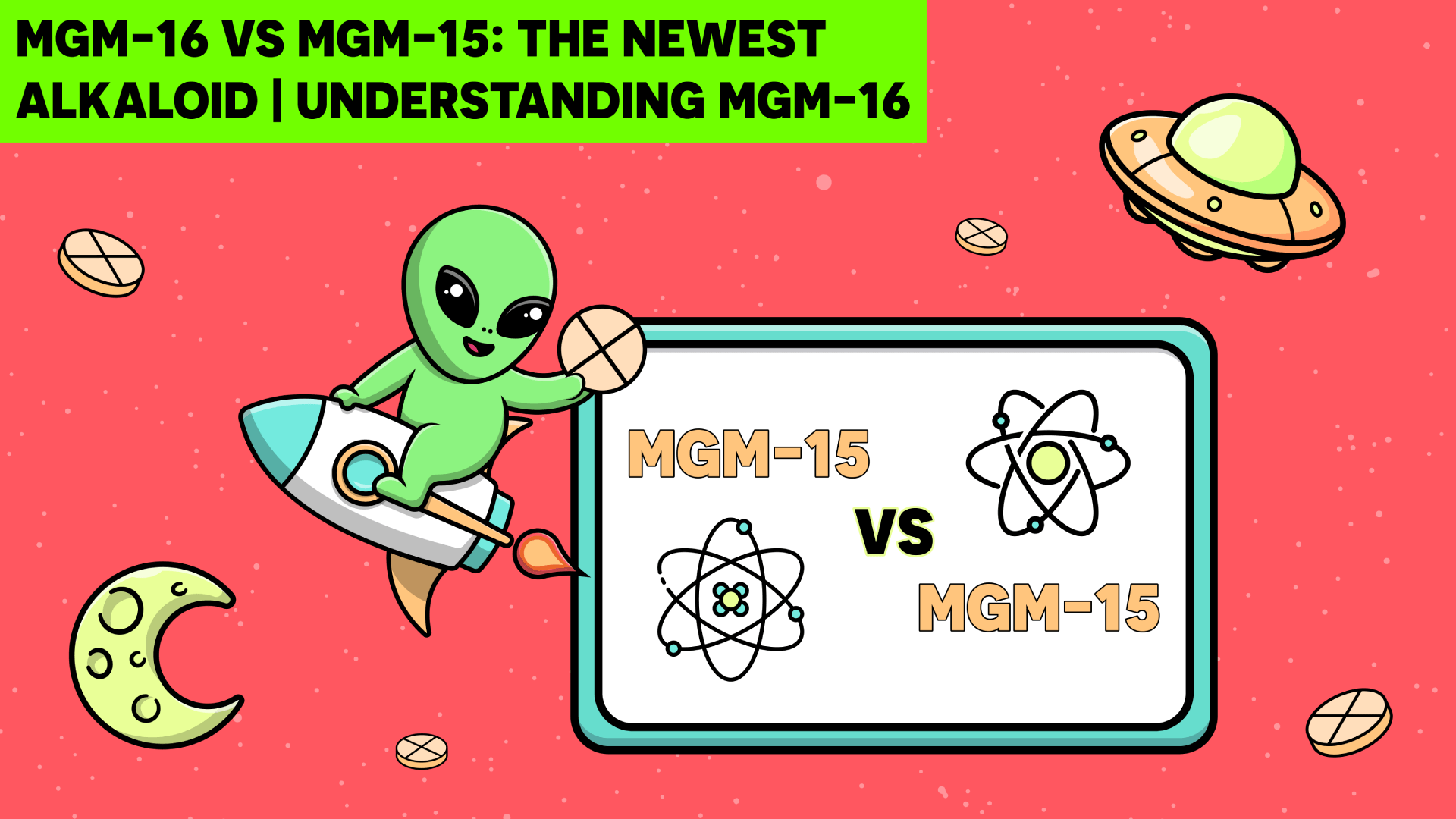
If you keep seeing MGM-16 mentioned as the newest and strongest kratom-derived compound, and you’re wondering how it’s different from MGM-15, this guide breaks it down in plain language.
We’ll cover where both compounds come from, how they actually differ, why MGM-16 is considered more potent, and the legal reality in 2026. These are serious compounds in the middle of federal scheduling, so the goal here is clear, honest understanding, not hype.
The Quick Answer
MGM-15 and MGM-16 are both semi-synthetic compounds built from 7-OH, the potent kratom alkaloid. MGM-16 is the newer of the two and is more potent, mainly because it adds a fluorine atom to the structure. Both act as strong opioid-receptor agonists, and both are named in the same July 2026 DEA action heading toward Schedule I. Newer and stronger, in this case, does not mean safer.
The 7-OH Family Tree
To understand these two, start with the parent compound.
Kratom leaf contains mitragynine, its main alkaloid, and a trace of 7-hydroxymitragynine, or 7-OH. 7-OH is far more potent than mitragynine at the opioid receptors. Once chemists had 7-OH to work from, they began making modified versions of it in the lab to change its potency and properties.
MGM-15 and MGM-16 are two of those modified versions. Both keep the core structure of 7-OH but change it in specific ways to make it bind the opioid receptors more strongly. Mitragynine pseudoindoxyl, which you may have seen in products like Eighties Pseudo, is another relative in this family. So think of MGM-15 and MGM-16 as the lab-enhanced descendants of 7-OH.
What Is MGM-15?
MGM-15 is the dihydro version of 7-OH. In plain terms, it’s 7-OH with a small structural change that makes it a stronger agonist at the mu and delta opioid receptors than 7-OH itself.
It’s been sold as a designer compound since around early 2025, showing up in tablets, candies, and shots, often marketed as a kratom extract even though it’s a semi-synthetic opioid. We cover its state-by-state legal status in detail in our MGM-15 legality guide.
What Is MGM-16?
MGM-16 is the newer relative, and the key difference is a fluorine atom added to the structure. The DEA refers to it as a fluorinated derivative of 7-OH. That single change matters, because adding fluorine in this position increases how tightly the compound binds the opioid receptors.
MGM-16 isn’t brand new to science, even if it’s new to the consumer market. It was studied years ago in academic research as an orally active mu and delta opioid dual agonist, and in animal studies it showed a strong effect against neuropathic pain. That research history is part of why it’s described as potent. It’s important to be clear, though, that this was laboratory and animal research, not approval for human use. HHS has stated these compounds have no currently accepted medical use.
MGM-16 vs MGM-15 Head to Head
Here’s the comparison in one place.
| Feature | MGM-15 | MGM-16 |
|---|---|---|
| Origin | Semi-synthetic derivative of 7-OH | Semi-synthetic derivative of 7-OH |
| Key structural difference | Dihydro form of 7-OH | Adds a fluorine atom to the structure |
| Relative potency | Stronger than 7-OH | Stronger than MGM-15 |
| Opioid receptor activity | Mu and delta agonist | Mu and delta agonist, higher binding affinity |
| Research background | Newer designer compound | Studied academically as a potent dual agonist |
| 2026 legal status | Named in DEA Schedule I action | Named in the same DEA Schedule I action |
The takeaway is straightforward. Both are potent opioid-receptor agonists derived from 7-OH. MGM-16 sits a step above MGM-15 on potency because of that fluorine addition. And critically, they’re treated together by regulators, not separately.
Newer and Stronger Is Not Safer
It’s easy to read “newer and more potent” as “better,” so let’s reframe that honestly.
With opioid-receptor agonists, higher potency generally means the margin for error gets smaller, not larger. A more potent compound can carry a higher risk of dependence, tolerance, and dangerous effects like slowed breathing, especially when it’s sold in inconsistent products with unclear dosing. The fact that MGM-16 binds more tightly than MGM-15 is a reason for more caution, not less.
There’s also the marketing problem. These compounds are often sold as kratom extracts even though they’re semi-synthetic opioids, which means buyers may not realize how strong what they’re taking really is. That mismatch between the label and the reality is a big part of why health agencies stepped in.
Are MGM-16 and MGM-15 Legal in 2026?
Both are on the same regulatory path, so this part is simple to summarize.
As of July 2026, neither MGM-16 nor MGM-15 is federally scheduled yet, but that’s about to change. On July 1, 2026 the DEA filed to temporarily place 7-OH and its related substances, specifically naming mitragynine pseudoindoxyl, MGM-15, and MGM-16, into Schedule I. The notice published in the Federal Register on July 6, 2026, and the temporary order is expected to take effect around early August 2026.
At the state level, places that have moved against 7-OH analogs, like Florida and Ohio, have swept these compounds in as well, and broad kratom bans in states such as Alabama, Arkansas, Indiana, Louisiana, Vermont, Wisconsin, Connecticut, and Tennessee likely capture them too. For the fuller state picture, see our MGM-15 legality by state guide, which applies closely to MGM-16 given they’re covered by the same action. Verify your own state before assuming anything.
Frequently Asked Questions
Q. What is the difference between MGM-16 and MGM-15?
Both are semi-synthetic compounds derived from 7-OH. MGM-16 adds a fluorine atom to the structure, which makes it bind the opioid receptors more tightly and gives it higher potency than MGM-15.
Q. Is MGM-16 stronger than MGM-15?
Yes. Research indicates MGM-16 has greater opioid-receptor binding affinity than MGM-15, largely due to the added fluorine. That means it’s more potent, which calls for more caution, not less.
Q. What is MGM-16?
It’s a fluorinated, semi-synthetic derivative of 7-hydroxymitragynine that acts as a potent mu and delta opioid-receptor agonist. It was studied years ago in academic pain research but has no accepted medical use.
Q. Is MGM-16 legal?
As of July 2026 it’s not yet federally scheduled, but the DEA has filed to place it into Schedule I temporarily, with the order expected around early August 2026. Some states already cover it through 7-OH analog bans.
Q. Are MGM-16 and MGM-15 natural?
No. Both are semi-synthetic, meaning they’re chemically modified in a lab starting from a kratom alkaloid. They’re not naturally present in kratom leaf in any meaningful amount.
Q. Why were MGM-15 and MGM-16 created?
They were developed as more potent modifications of 7-OH. In the consumer market, analogs like these have also been used to sidestep bans on 7-OH, which is exactly why regulators name them specifically.
Q. Is MGM-16 a synthetic opioid?
It’s a semi-synthetic opioid-receptor agonist derived from a kratom alkaloid. HHS has stated the related substances have no accepted medical use and a high potential for abuse.
Q. Is MGM-16 the same as 7-OH?
No. MGM-16 is a modified, more potent version of 7-OH. They’re distinct compounds, which is why the DEA lists them separately.
Q. Should I be worried about products labeled as kratom that contain MGM-16?
Be cautious. Some products marketed as kratom extracts have contained semi-synthetic opioids like MGM-15 and MGM-16, which are far stronger than kratom leaf. Read labels, favor transparent lab-tested products, and know that these specific compounds are being scheduled.
The Bottom Line
MGM-16 and MGM-15 are close relatives, both semi-synthetic opioids built from 7-OH, with MGM-16 being the newer and more potent of the two thanks to a fluorine addition. That extra potency is a reason for more caution, not a selling point.
Both are covered by the same July 2026 federal scheduling action and are expected to be Schedule I nationwide within weeks, on top of state bans already in place. If you want the detailed legal breakdown, read our MGM-15 legality by state guide, which applies to MGM-16 as well.
This article is for general information and isn’t legal or medical advice. MGM-15 and MGM-16 are potent semi-synthetic opioid compounds with a rapidly changing legal status. Verify current federal and state law before acting. These statements haven’t been evaluated by the FDA.